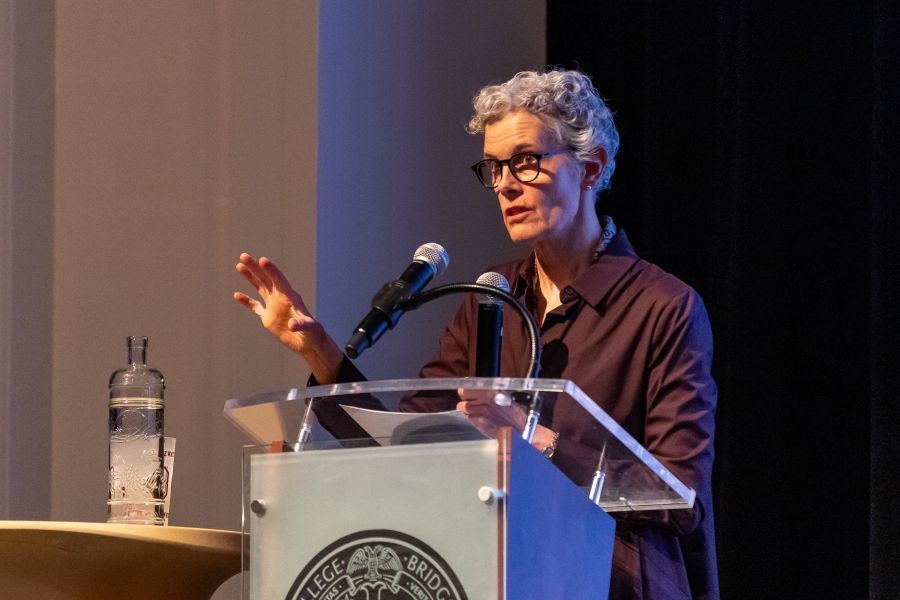
When award-winning author and journalist Maggie Jackson took the stage in Cole Hall earlier this week, she opened her Endowed Lecture with a question: When you hear the word “uncertainty,” what comes to mind?
Among the audience responses were “fear,” “weakness” and “creativity.”
It was that third response—perhaps given by an attendee who was already familiar with Jackson’s work—that she expanded on during her talk, “Uncertainty’s Surprising Wisdom.” Jackson argued that despite the popular belief that associates uncertainty with negative emotions or incompetence, the state of being unsure and skeptical actually increases one’s mental flexibility and can lead to better outcomes.
“We live in a time of volatility and unpredictability,” Jackson said. “Uncertainty is a productive force, not something to dread and fear.”
Jackson used examples from the fields of science and medicine to argue that uncertainty causes a “good stress” that makes us more open to other ideas, more adaptable in finding solutions to problems and more open to collaborating with other people.
“When you are uncertain, you have heightened attention and are more receptive to new data,” Jackson said. “Uncertainty is at the root of good collaboration [and] critical for being present to the challenges we face.”
Jackson urged attendees to lean into the uncomfortable feeling of not always knowing the answer to a problem or challenge. In those moments, she said, we should take a pause, listen to other perspectives and consider that there might be something new to learn. She said this is particularly important in work or team environments when there is often pressure for the group to quickly come to a consensus and move forward.
“Agreement as a norm is toxic for a team,” she said. “Teams that allow for respectful disagreement are more effective. And when teams disagree, they often unearth hidden expertise…. Treat people who ask questions as a benefit, not a troublemaker.”
She also encouraged the audience to practice doing things that put them in situations where they face uncertainty. As an example, Jackson said she tries to swim in the ocean every day—something that is always unpredictable and often surprising.
“Experiment. Try a bit of the unknown,” she said.
Jackson’s talk was based on the research she did for her 2023 book Uncertain: The Wisdom and Wonder of Being Unsure. Nominated for a National Book Award, Uncertain explores why we should seek not-knowing in an era of flux and angst. The book was also named an Amazon Top New Release and selected as one of the 25 best non-fiction titles of 2024 according to the Next Big Idea Club led by Malcolm Gladwell, Susan Cain, Dan Pink and Adam Grant.
Jackson was previously a columnist for The Boston Globe and foreign correspondent for the Associated Press in Europe and Asia. An earlier book, Distracted: Reclaiming our Focus in a World of Lost Attention, sparked a global conversation about the costs of fragmenting our attention and won the 2020 Dorothy Lee Book Award for excellence in tech criticism.
This final Endowed Lecture of the 2025-26 academic year was sponsored by the Anna B. Mow Symposium on Comparative Religious Ethics. The schedule for 2026-27 talks will be available in August.
– Heather Cole
3/26/26

