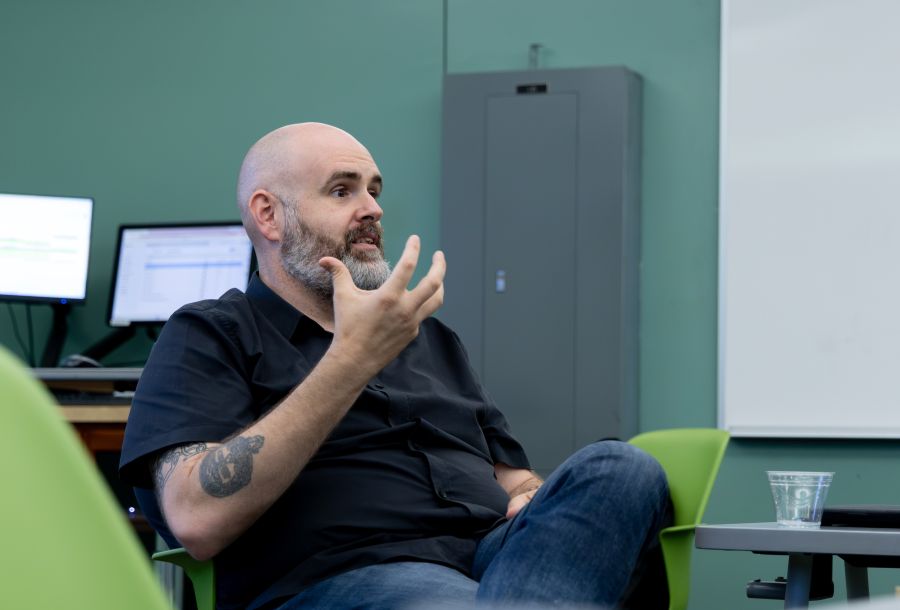
Dr. Sam Hamilton, Associate Professor of English, is quick to admit that he hates the party game Apples to Apples because, in his words, “it gets stale really fast.” But among the things that Hamilton discovered during the research project he conducted this summer with Acen Hite ’27 is that a great way to liven up the game is to invite AI to the table.
“It turned [Apples to Apples] from a light-hearted competitive game into a cooperative game” where the human players worked together to defeat AI, Hamilton said. “Players would choose cards that they thought AI wouldn’t pick. And as soon as a human won, everyone cheered.”
According to Hamilton, the introduction of AI—in this case the tools ChatGPT, Gemini and Claude—as a fellow competitor turned the game into humans vs. AI in a way that surprised Hamilton and suggested the possibility of how AI might be used to change the dynamic of other games.
“Currently, a lot of game developers look at AI as a threat, or a tool in their belt,” Hamilton said during a recent talk about the team’s work. “But we learned that you could change the player experience based on whether you are playing against AI or not.”
For the uninitiated, Apples to Apples is a card-based word association party game. Players start with a hand of “red apple” cards on which are written nouns. One player is the judge, and that person plays a “green apple” card which features an adjective. The goal is to get the judge to pick a player’s “red apple” card as the best match for the “green apple” card. The role of judge rotates, and the winner is the player whose “red apple” cards get picked most often.
The complicating factor in the game, however, is that the judge doesn’t always pick the most literal match. Sometimes the judge picks a silly or ironic or ridiculous match. So, part of the game is figuring out the other players’ styles and the judges’ preferences.
“When you play Apples to Apples you play based on your opponent and the situation,” Hamilton said. “That is something that LLMs can’t get. At least not yet.”
As Hamilton explains it, large language models (LLMs) and large reasoning models (LRMs) such as Claude and ChatGPT are good at playing games that are based in logic—say, checkers or chess. But they struggle to play games like Apples to Apples, which is not always logical. Hamilton and Hite, a computer science and game design major, were curious as to whether they could train the AI tools to get better at playing the game.
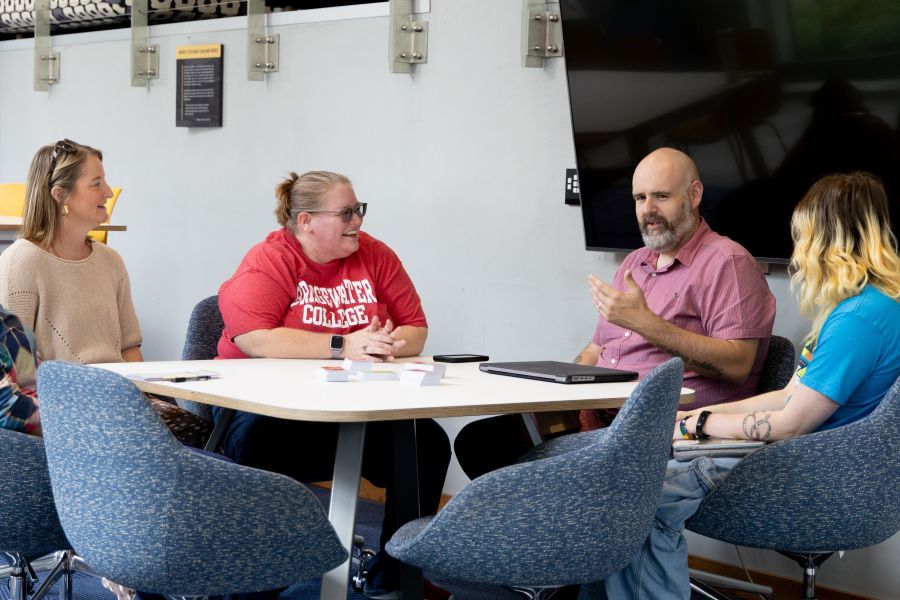
In their project, “AI-pples to AI-pples: Testing the Creativity and Empathy Limits of LLM/LRMs with a Card-Based Party Game,” funded by The Research Experience @ Bridgewater (TREB), Hite and Hamilton recruited teams to play the game against the three AIs, logged the players’ decisions, and then input that information into the tools. Then the humans played the trained tools, and Hamilton and Hite analyzed the results to determine if the AIs got better at playing Apples to Apples once they knew what cards the judges had previously selected.
The results were… inconclusive. According to their analysis, Claude got better at playing Apples to Apples after training, but Gemini and ChatGPT actually got worse. Hamilton said they would need to replicate their study on a larger scale and in a more controlled environment in order to better understand why some of the tools performed worse after training, but that the results suggest that there might just be some things that AI is not capable of doing as well as a human.
Regardless, he said it was a fun project to work on, and both he and Hite enjoyed watching the dynamic that was created when the humans teamed up against AI.
“Don’t let anyone convince you that AI is an inevitability, either for good or for bad,” Hamilton said. “Our future relationship with AI technologies has not been etched in stone to be handed down from on high by some techbro Moses. To quote Mike Cooley’s parting words from Architect or Bee? The Human Price of Technology, ‘The future has yet to be built by people like you and me and we do have real choices.’”
Hamilton will give a talk about their research on Saturday, Sept. 12 at 6 p.m. at the Harrisonburg Nerd Nite at Broad Porch Coffee and Café, 57 Court Square in Harrisonburg, Va. Hite will also present on their research at ASPIRE: A Celebration of the Arts, Scholarship, Performance, Innovation and Research Excellence, to be held on campus in spring 2027.
– Heather Cole
Published: July 20, 2026

